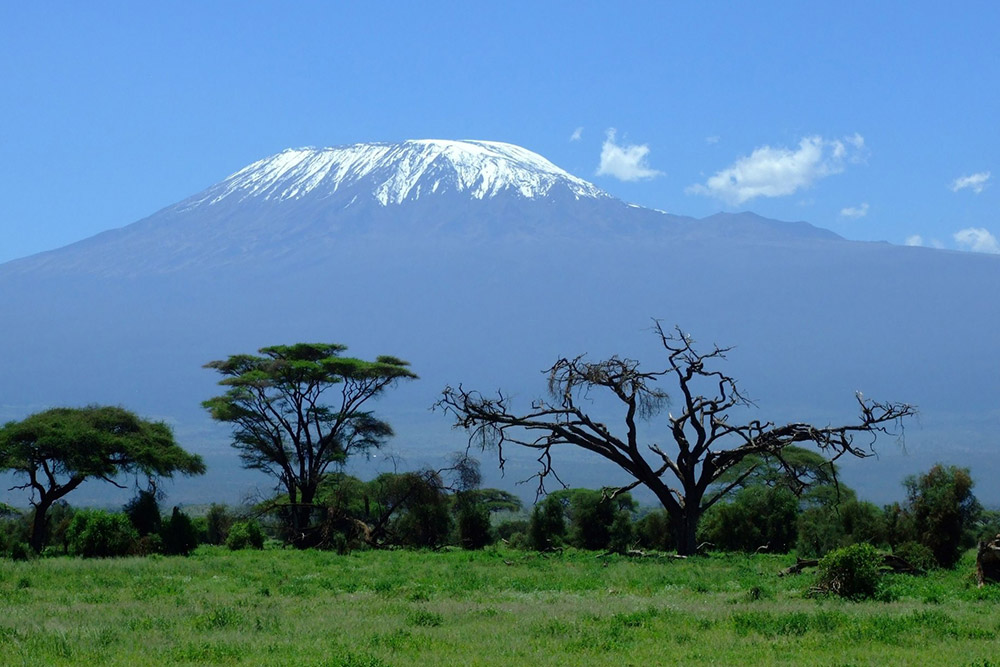
Also known as the roof of Africa, Mount Kilimanjaro is a UNESCO World Heritage site and the highest peak in Africa. The mountain (now a dormant volcano) rises approximately 16,000 feet from its base to a summit of 19,341 feet above sea level. The mountain is located in the north of the country on the border with Kenya in the town of Moshi and is accessible via Kilimanjaro International Airport. The mountain is part of Kilimanjaro National Park, the second most popular park in the country.
The mountain is one of the most accessible high peaks in the world and has an average success rate of around 65%. Being one of the most popular mountains in the world, roughly 50,000 trekkers every year try to reach the summit of Mt Kilimanjaro. However, summit success rate heavily depends upon what route is climbed as routes vary considerably in terms of acclimatization profile and duration of the climb. The highest point is Uhuru Peak, which is one of the Seven Summits of the world.
There are seven official trekking routes by which to ascend and descend Kilimanjaro: Lemosho, Lemosho Western-Breach, Machame, Marangu, Mweka, Rongai, Shira, and Umbwe.
Though the climb is not technically as challenging as the Himalayas or Andes, the high elevation, low temperature, and occasional high winds can make Kilimanjaro a difficult trek. Acclimatization is required, and even experienced and physically fit trekkers may suffer some degree of altitude sickness. A study of people attempting to reach the summit of Kilimanjaro 77% experienced acute mountain sickness, defined in this study to be headache, nausea, vomiting, or loss of appetite.
Kilimanjaro’s summit is well above the altitude at which life-threatening high altitude pulmonary edema (HAPE) or high altitude cerebral edema (HACE), the most severe forms of acute mountain sickness, can occur. These health risks are increased substantially by excessively fast climbing schedules motivated by high daily national park fees, busy holiday travel schedules, and the lack of permanent shelter on most routes. It is necessary to trek with a licensed guide.
Taking into consideration permit fees, park fees, camping and food logistics, the only realistic way to climb the mountain is with a tour operator. A decent ethical climb by an authorized local no-frills operator on a short 6-day route may start from around US$1,500 when climbing with a group. However, the 5 or 6 day routes also have the lowest summit success rates and are thus not recommended. For a responsible 7-day climb, a reasonable budget is at least $1,800 to $2,000.