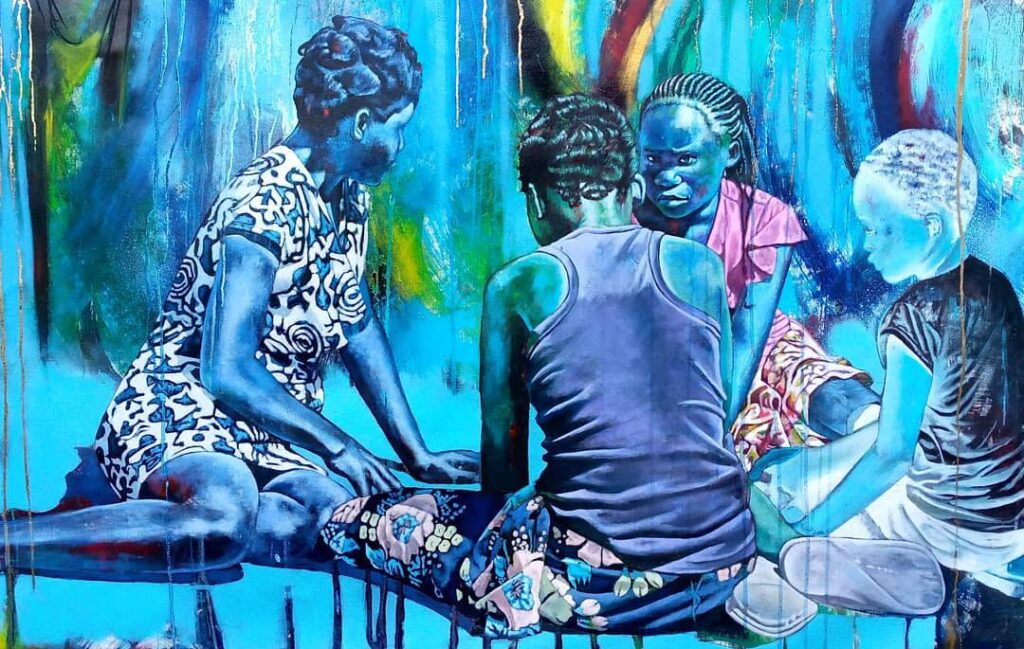
While the world is looking in another direction art flourishes in the country on a shoestring. The desire of artists in Zambia to create is so strong that they will use anything. From burlap sacks to car paint, even old bed sheets are often used in the place of canvases as the materials for art. Garbage and detritus are turned in works of art that are often staggering in their scope. The tradition of fine art, in the Western concept of the term, in Zambia goes back to colonial times and has been steadily growing ever since.
Thanks to the Lechwe Trust, Zambia’s body of art is assured a home in the country it was created.
The Lechwe Trust was founded by Cynthia Zukas. An artist herself, in the early 1980s Zukas was a friend to many artists in Zambia including William Bwalya Miko, who remembers with fondness how Zukas would return from trips abroad with cases full of art materials to pass on to local artists who had no access to such tools. In 1986, she came into an inheritance and decided it was time to support artists more substantially, and the Lechwe Trust was born.
Their aim was to provide bursaries for artists who wished to study formally or attend art workshops and residencies. They decided to start a collection, ensuring an art legacy for Zambia. The collection houses works predominantly by Zambians, however there are works by those who have lived in Zambia or have a connection with the country. Now numbering over 200 pieces of art from paintings to sculpture, from etchings to sketches, the legacy is one of which Zambians are proud of.
Lusaka is bursting at the seams with artists and The Henry Tayali gallery — Lusaka’s main fine art gallery — is filled almost from floor to ceiling with works of art, and the gallery is a hub of activity. Through art, one can express oneself without the ability to read or write. The community of artists is a warm and friendly one full of people who understand that their richest resource is one another; new members are welcomed into the fold with open arms.
There is a more abstract and perhaps rarely articulated motivation also, a pride and desire to depict and explore Zambia using the visual medium. Through their work, Zambian artists exude a dignity and an understanding of the good and bad of their society. They question, they examine and sometimes judge; the conversation shows no signs of abating. Artists here just love art, they thirst after it and it is a crucial contribution to their sense of identity, their sense of purpose.